.
.
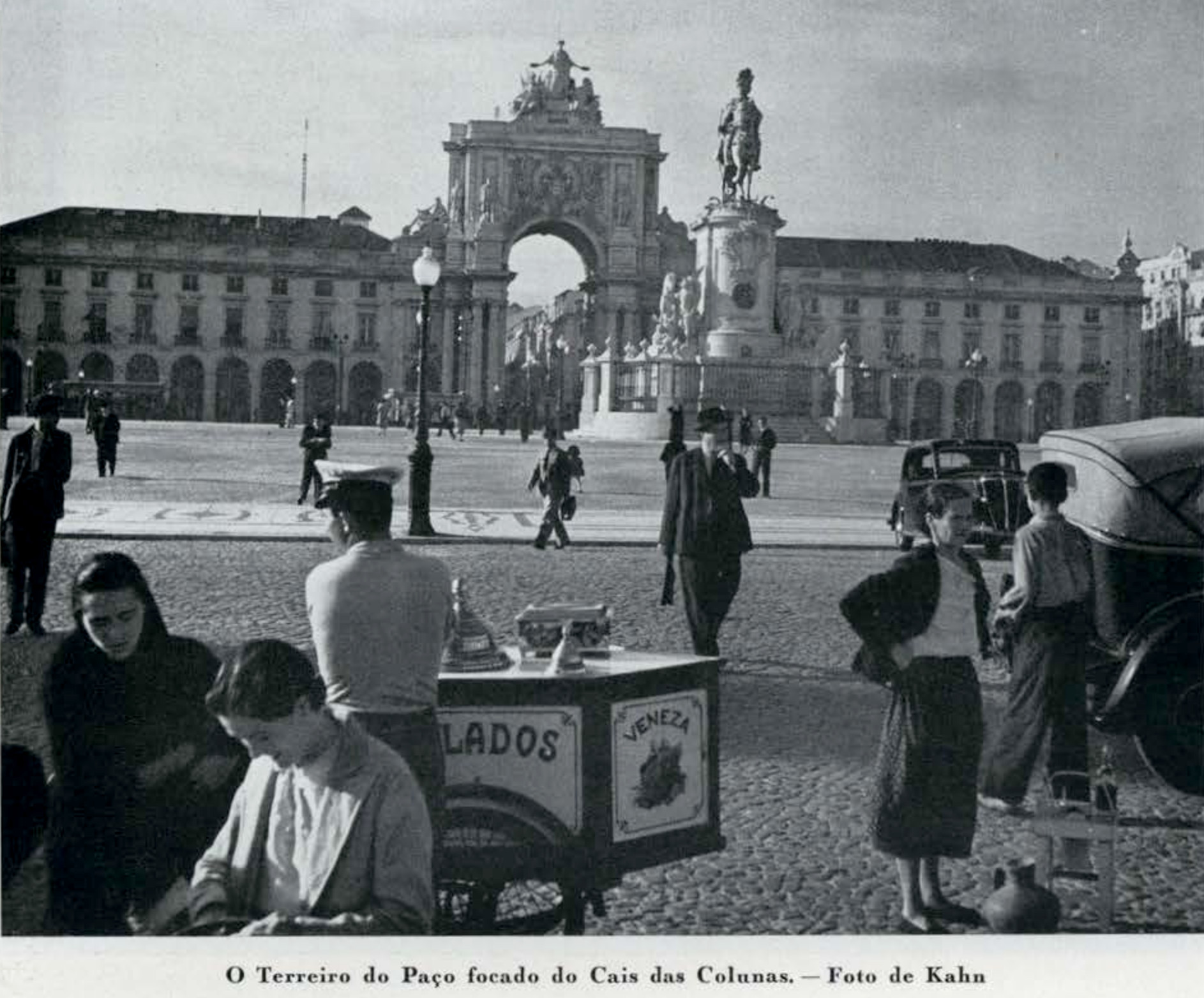
Terreiro do Paço in Lisbon. Photograph taken by Roger Kahan, a Jewish refugee and professional photographer who photographed the Portuguese capital in late 1940.
(Picture: Roger Kahan - Revista Panorama Magazine (1946))
“Another category of foreigners attracts the attention of the Portuguese more insistently. They are the many members, employees and officials of the German Legation and of its consular, press, information and other departments. This unwanted category of foreigners imposes itself in a way that causes astonishment among visitors to Lisbon. It is not uncommon, when walking down the street or sitting in a café, to hear — loudly — the greeting ‘Heil Hitler’. Their healthy appearance, well-fed faces, well-filled wallets and perfectly pressed clothes leave the justified suspicion that these beneficiaries of National Socialism have been living a far richer life there than their fellow citizens in Germany.”
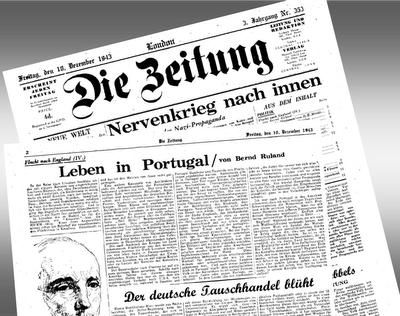
This is one of the descriptions of the Portuguese capital written by Bernd Ruland, a refugee who travelled from southern France to Lisbon to escape the Nazi regime. The text was published in December 1943 in the newspaper “Die Zeitung”, edited and distributed among German refugees living in England.
.
The concentration camp in Spain
When the Germans invaded France, Ruland escaped to the south of the country, where the so-called “free zone” with its capital in Vichy had been created. He believed that the government led by General Pétain would not bow to Hitler’s demands, but time eventually showed that it was nothing more than a puppet government that complied with Nazi requirements.
.
.
The newspaper "Die Zeitung" and the article where Bernd Ruland recounts what he saw in Lisbon..
In 1942 the Vichy government withdrew residence permits and travel authorizations from foreigners. Ruland and his wife realized that they would eventually be handed over to the German authorities. Stateless — since the German government had stripped Jews and political enemies in exile of their nationality — they managed to cross the border into Spain, where they were arrested and interned in the concentration camp of Miranda del Ebro.
After the Allied invasion of North Africa at the end of 1942, the Spanish realized that the possibility of an Allied victory in the war was increasing. Francisco Franco ordered the closure of the prison complex where refugees and Allied soldiers captured in Spanish territory had been held.
Ruland arrived in Lisbon on the Lusitânia Express, the train that connected the two Iberian capitals “without stops in just 12 hours, whereas before it took 20,” he explained in articles he wrote between October and December 1943. He then prepared for a wait that would eventually take him to the United Kingdom.
In the series of articles he called “Flucht nach England” (“Escape to England”), Ruland describes the environments and places through which he passed.
.
English and Americans greeted in the street
One of the articles — “Leben in Portugal” (“Life in Portugal”) — is dedicated to our country. In it he wrote about the thousands of refugees strolling through the streets of the capital and about the fact that the authorities had fixed their residence in surrounding towns in order to avoid chaos in Lisbon.
He also spoke of the desire to leave.
He recalled a Tagus River full of ships departing for various destinations — especially America — but sailing empty because visas for other countries could not be obtained, nor money to buy tickets to freedom.
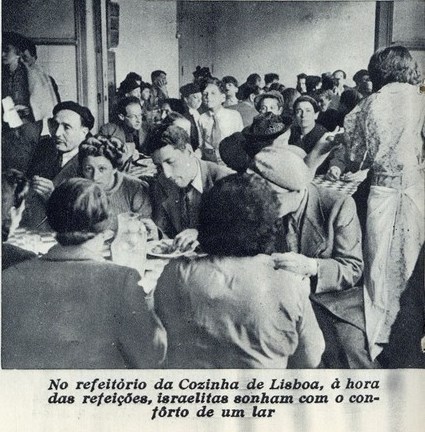
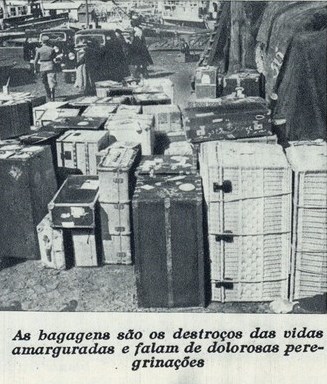
The Economic Kitchen, a cafeteria where Jewish refugees could eat their meals, and suitcases of refugees waiting to board a ship at one of Lisbon's docks.
(Pictures: Roger Kahan/ Mundo Gráfico 08/1941)
Ruland also had the impression that the Portuguese government might abandon neutrality, considering the military preparations and defense arrangements that were visible in several places.
On the other hand, he mentioned the widespread sympathy for the “centuries-old” British alliance, while some antipathy could be felt toward the German cause and especially the Japanese one, due to the invasion of Timor and the tensions existing in Macau.
To reinforce this idea he described the reaction of the Portuguese to the announcement of the Italian surrender, signed on September 3, 1943 and made public five days later: “crowds gathered around the newspaper stands. The subject was discussed animatedly and, if they saw someone who looked English or American, they shook his hand, congratulating him. This atmosphere represented a radical change for people who, like me, came from Axis countries or from countries sympathetic to the Axis.”
“And there is another aspect that struck me very strongly. Among the Portuguese, racial hatred — whether toward Jews or toward Black people — is completely unknown,” he emphasized in the article.
“In the country that 400 years ago expelled all Jews from its territory, there are today small associations protected by law, and Jews are accepted in all professions, with no anti-Semitic propaganda visible,” concluded Bernd Ruland in an admiring tone, before referring to his arrival in England through a BOAC civilian flight that periodically departed from Portela airport bound for Whitchurch, in Bristol.
Carlos Guerreiro
Sources:
"Die Zeitung" § Mundo Gráfico § Panorama
