

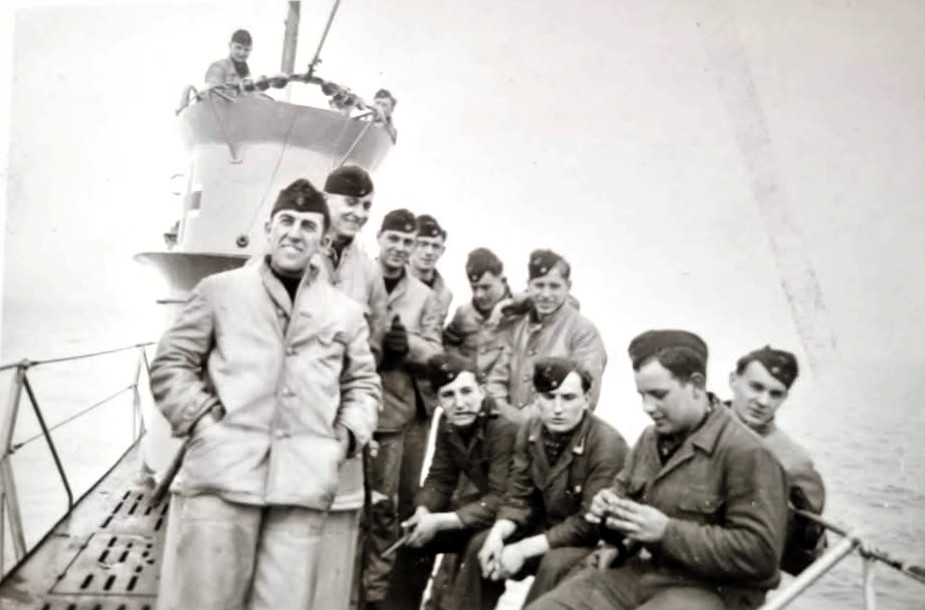
Moments of fresh air on high seas !
( Photo by Josef Klein, courtesy of Rinaldo Netto, nephew )
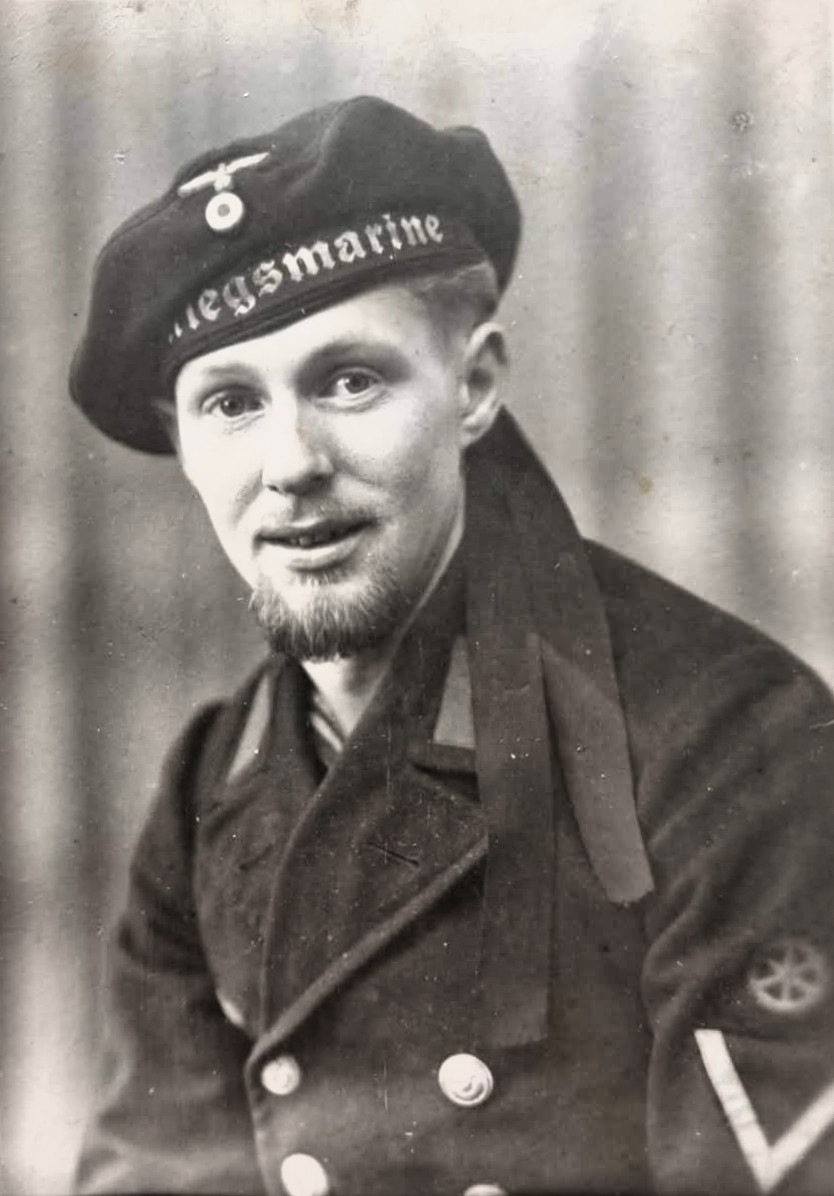
Photograph of Josef Klein
( courtesy of Rinaldo Netto, nephew )
Joseph Klein, 21, was a mechanic aboard U-43 and was supposed to be inside the German submersible when the alarms went off once again. They warned of the presence of enemy planes. Since leaving France in mid-July 1943, they had suffered at least two air raids, without consequences. This time luck didn't smile on them...
The two American planes that had taken off from the USS Santee located the U-43 accompanied by another submarine - possibly the U-403 - at 17:11 hours on July 30 and attacked immediately. The first to dive was Lieutenant Edward VanVranken's Wildcat fighter which made a machine gun attack on the two u-boats in a row. The Germans attempted to submerge the ship, which was taken advantage of by the Avenger torpedo plane - with Lieutenant Robert Richmond at the controls - to drop depth charges on one of the ships that was closest to the surface and a pair of mines on the other.
The first u-boat emerged. The fact that he left an oily trail indicated that he was wounded, but he continued to resist using anti-aircraft weapons to keep the planes from the USS Santee away. By nightfall he managed to escape, despite other American aircraft trying to reinforce his comrades. One of the American fighters would return with several marks from this confrontation.
The other, certainly U-43, was not so lucky. The aviators first spotted a boil and then an explosion rising from the depths. An oil slick and some debris, just over 400 miles southwest of Pico Island, marked the end of the lives of Joseph Klein, his captain Hans-Joachim Schwantke and 53 other crew members.
Submarine communications during this period were very short and spaced out to avoid being located by the Allies, and so what happened to the U-43 would only be known at the end of the war. The traveling companion - the U-403 - would end up being sunk nineteen days later off the coast of Dakar without anyone having noticed what had happened. On 18 August U-Boat Headquarters (B.d.U.) again issued orders to U43, giving her permission to operate at will between Freetown and Spanish Guinea. In the German document, however, a handwritten note already shows some concern: "There was still news."
In the B.d.U. diaries the alarm finally goes off on 8 September: "U-43 had orders to lay mines off Lagos and then report the execution of the task. So far this message has not been received, nor has there been a response to the request for position. The last news are dated 23 July when U-403 made a short signal for refuelling and also communicated to U-43 that it had managed to pass Biscay. south. There is however no other concrete evidence".
A long and painful period of uncertainty began for the family that would last beyond the end of the war. Josef, son of Adam and Katharina Klein, born on April 27, 1922 in Weidenthal, was only officially declared dead on September 6, 1943. And it was only in 1951, after an inquiry carried out by his sister, that the family was able to know more about his death. details what had happened to the young man. Cross-referencing the data from both parties allowed us to confirm the correct date of death.
Josef Klein's photographs and family information are now in the hands of Rinaldo Netto, Josef's nephew, who helped us prepare this article.
The converging routes of U-43 and USS Santee
U-43 left Lorient, France, on 13 July 1943 and to cross the Bay of Biscay paired up with U-403 which left Brest the same day. By this time, the u-boats had entered their dark period - from which they would never recover - and the passage to the Atlantic was normally made in pairs so that the vessels could provide mutual anti-aircraft support.
Since the beginning of 1943, the presence of aircraft, with radars and other technology, had grown significantly compared to previous years, making life very difficult for German submariners. In July 1943, the Allies were in the midst of Operation "Musketry", which combined groups of destroyers and other fast ships with heavy aircraft to try to make the Germans' passage through Biscay as difficult as possible. The fact that a submarine had about half the speed when submerged made its progress much slower, as well as constantly disrupting the crews' concentration.
U-43 and U-403 quickly felt the effects of Operation Musketry. Three days after setting sail they were attacked by a Sunderland seaplane which lasted 30 minutes and in which the U-43 was bombed, but without success. On the 19th, it was their turn to be spotted by a Liberator bomber from RAF Coastal Command, which swept them with machine gun fire. U-403 dives immediately, while U-43 returns fire and manages to hit the plane.
After the first confrontation, he also dived and, once submerged, the crew heard explosions in the water and believed they had managed to bring him down. The plane was indeed hit and one of its crew was injured, but the explosions that were heard beneath the waves resulted from the explosion of two torpedoes dropped from the aircraft.
During the same period, the USS Santee was part of a task group with the destroyers Bainbridge, Overton, and MacLeish.
The Santee had been converted from an oil tanker into one of several escort aircraft carriers that the Americans and British put to sea during this period. Smaller and less complex than the large aircraft carriers, they carried little more than a dozen aircraft and had with the mission of keeping aircraft in the air constantly to spot and attack any German or Italian submarines that they might spot, while protecting convoys of merchant ships.
On July 12, the American task group crossed the Atlantic south of the Azores with orders to attack and destroy the u-boats operating in the area. In a short period you will perform about a dozen attacks and three will be successful. On the 14th, U-160 sinks and sinks to the bottom with its 57 crew members. The following day, it was the turn of the 54 men from U-509 to meet the same fate northwest of Madeira.
In the following days it continues to circulate in that area. On the 18th, two of their planes sighted the island of São Miguel and circled part of the island. At nightfall on 26 July they met up with train GUS 10, which had left Bizerta, Tunisia, on the 18th and was headed for Hampton Roads, UAE. The convoy consisted of 47 merchant ships. The small group from Santee reinforced the 13 escorts that came from North Africa to help the ships pass through that area of the Atlantic that at that time had no air coverage from land.The Allied base in the Azores was not yet installed.
It was during the period of this escort that Santee's planes encountered U-43 and U-403, about 60 miles ahead of the convoy, with the results we have already exposed.
Carlos Guerreiro, António Fragoeiro e Rinaldo Netto
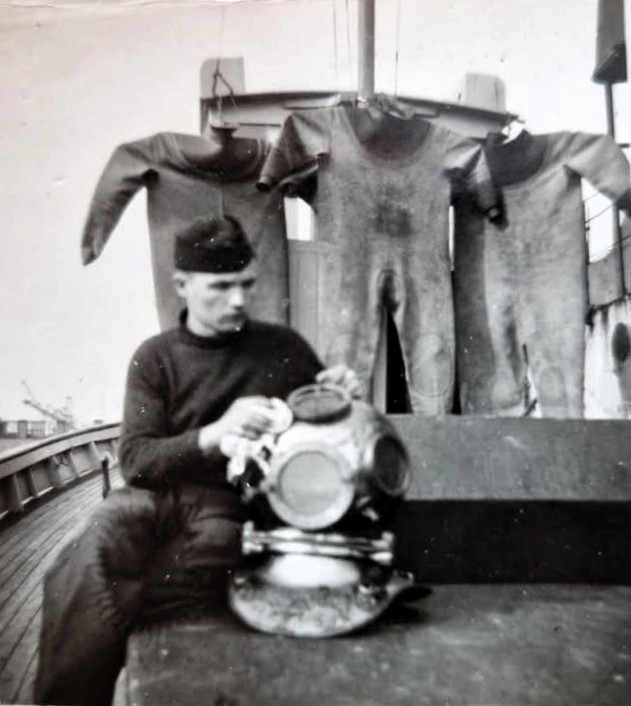
Josef Klein in moments of cleaning and maintenance of equipment
( courtesy of Rinaldo Netto, nephew )
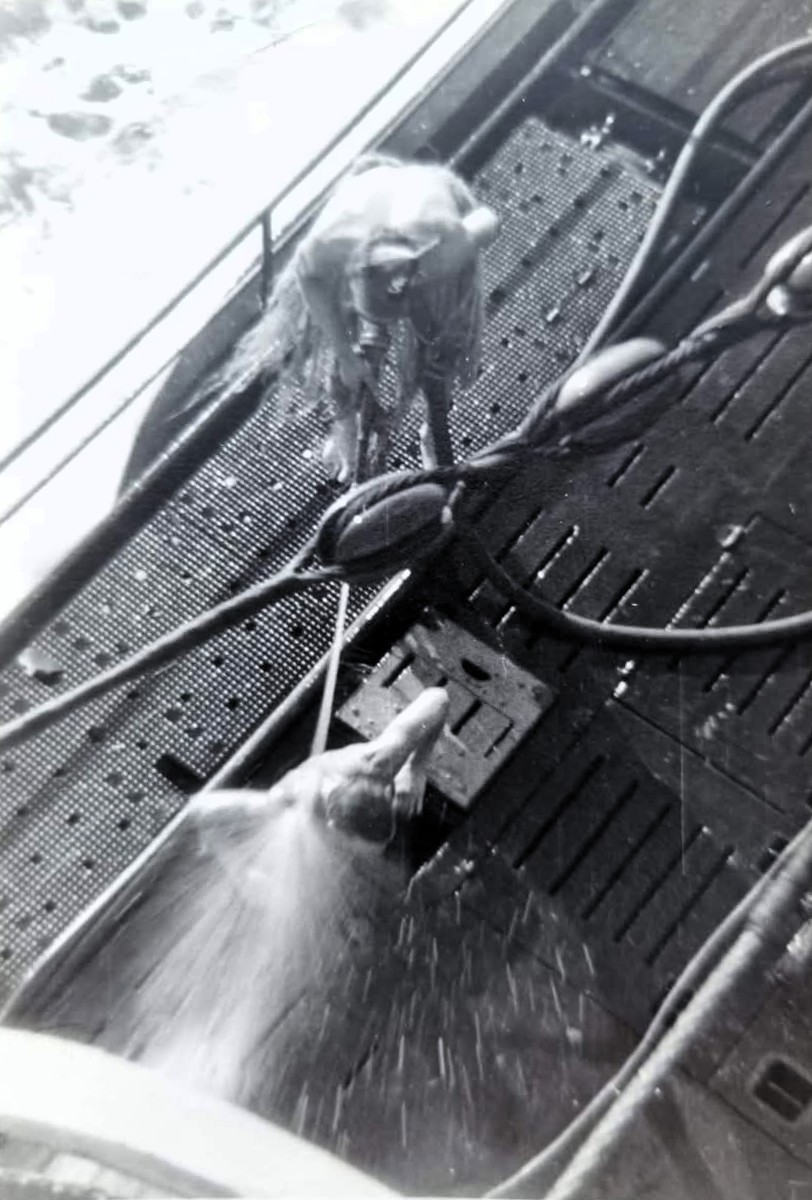
Shower on deck during patrol
( Photo by Josef Klein, courtesy of Rinaldo Netto, nephew )
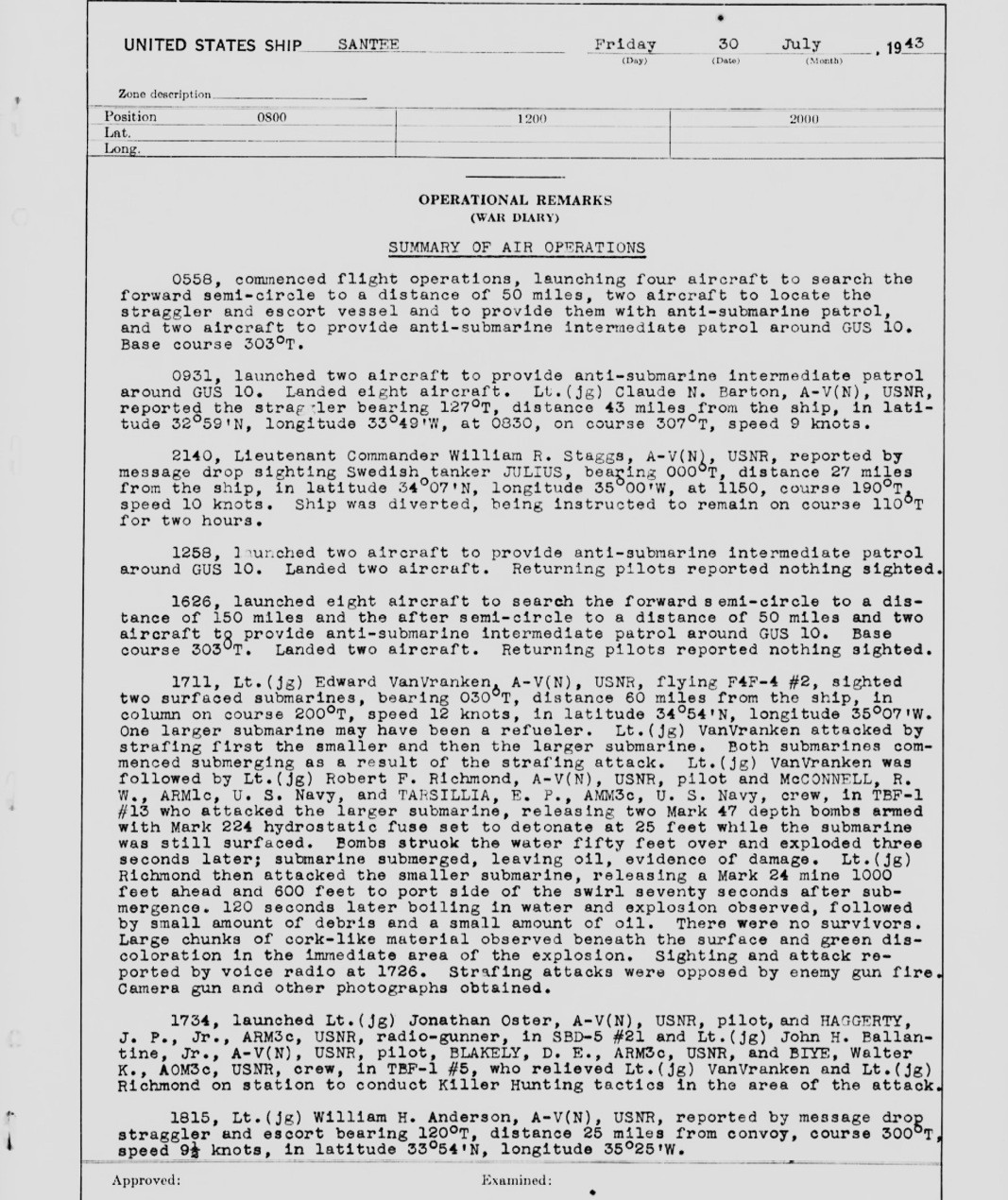
US Navy War Log Report on the Sinking of the Submarine
( War Diary, Nara, National Archives )
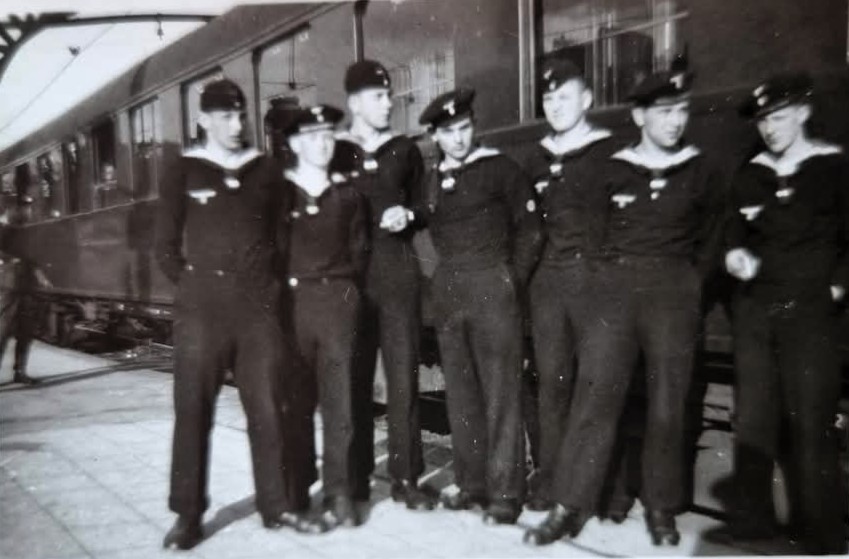
End of vacation, time of returning to boat
( Photo by Josef Klein, courtesy of Rinaldo Netto, nephew )
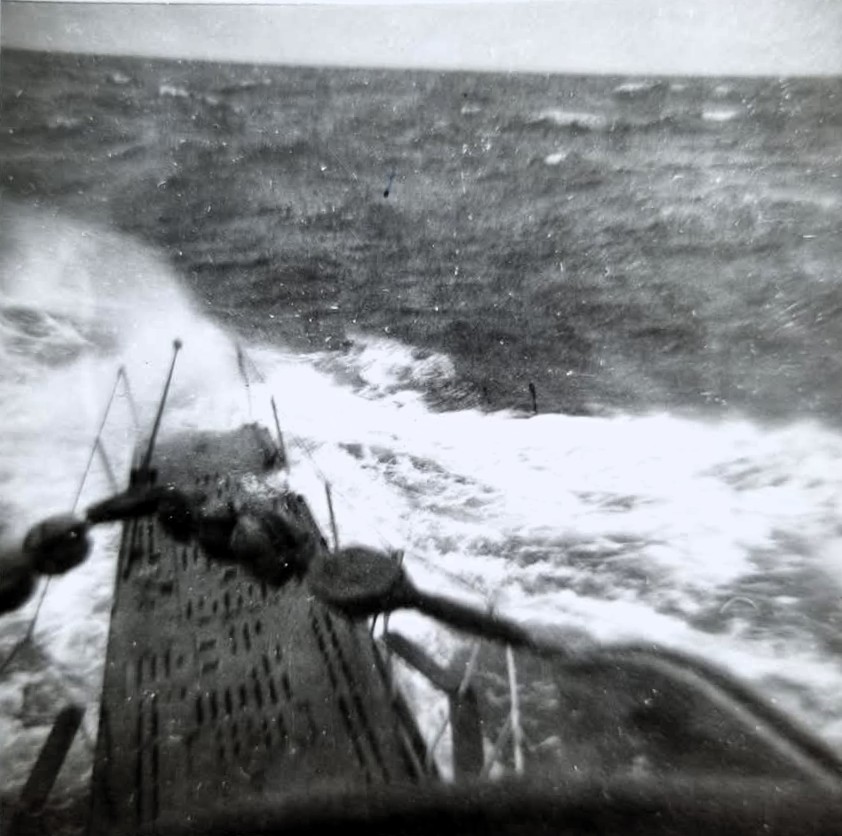
U-43 on high seas during patrol
( Photo by Josef Klein, courtesy of Rinaldo Netto, nephew )
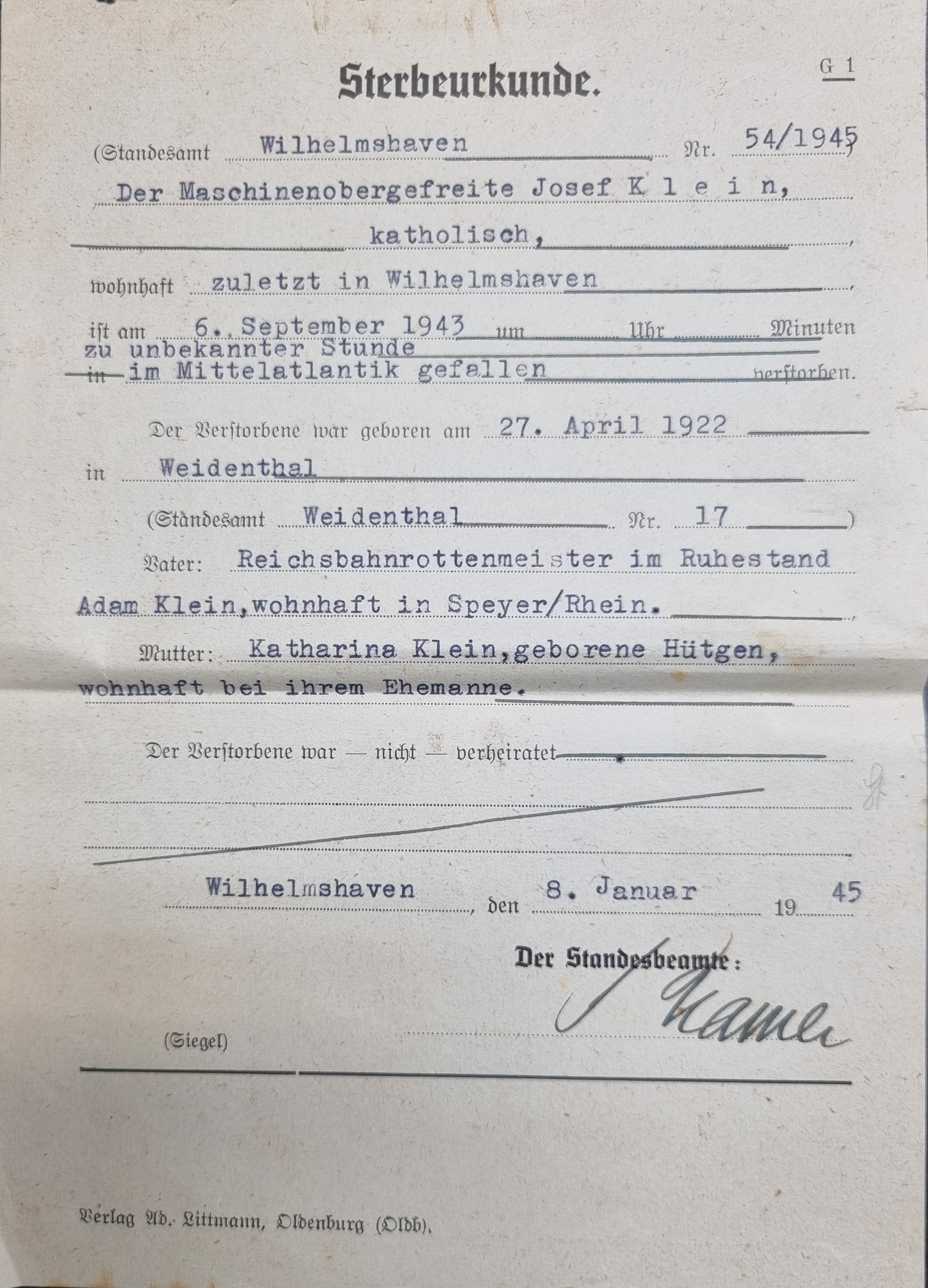
Death certificate of Josef Klein
( Courtesy of Rinaldo Netto, nephew )
Fontes/ Sources:
- Arquivos: National Archives UK, Kew (GB); Arquivo Histórico da Marinha (PT); Arquivo Histórico do MNE (PT); Álbum fotográfico de H.Mello, Colecção António Fragoeiro
- Sites: uboat.net;
- Livros: Shipping Company Losses of the second World War, Ian M. Malcolm; Lista dos Navios da Marinha Portuguesa, datas 1939 a 1945;
