.
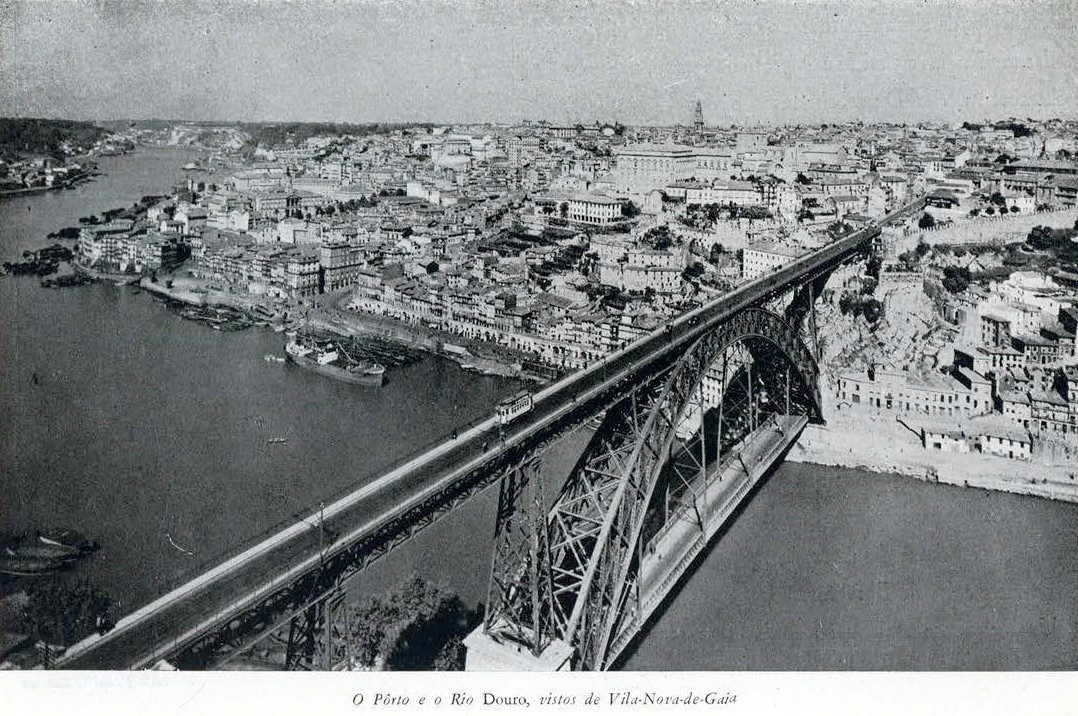
Panoramic view of Porto. Photograph published in the June 1941 edition of Panorama Magazine.
Max Arglebe, a German citizen who lived in porto during the Second World War, wrote, on 10 March 1940, a letter that not only portrays Portugal and the Portuguese but also presents some of the concerns of the German community residing in the country.
The letter was addressed to Franz Eher Nachfolger, a Berlin publishing house responsible for issuing several titles praising Nazi activity.
The company was directly controlled by the Nazi party and, among various books and newspapers, held the publishing rights to Mein Kampf. Among the periodicals it controlled was Schwarzes Korps, the official SS newspaper. In the letter, Arglebe thanked them for sending him this weekly, free of charge.
The letter also contains a postscript in which the author discusses the reception quality of German radio broadcasts. The letter was intercepted and translated by the PVDE — the Portuguese political police — which forwarded it to the Ministry of the Interior (Home Office). The document is accessible at the Portuguese National Archives in Torre do Tombo.
This article does not reproduce the entire letter, but only the essential passages relating to the themes already mentioned.
PVDE – Translation of the letter of 10 March 1940
Ref. Schwarzes Korps
Your letter of 20/02/40
“The press in Portugal in the larger cities is quite unfavourable to the Germans. Small and provincial newspapers publish news from the DNB or direct news from Germany, and their tendency can be considered more Germanophile. Provincial newspapers are generally published only once a week; circulation is quite limited. I can say that 80 percent of the country is against us.
The Portuguese reserve towards foreigners gives, in general, little opportunity to know them. He is very reserved and, in certain respects, an admirer of tradition, also from a political point of view.
(…)
A great influence on the country is the very ancient Alliance with England, which has left in the country a hostile position against Spain, which from time to time is reflected in rather bitter reports. From a commercial point of view, England has a very strong position and holds a large part of the country’s assets. One always hears first what England says, then France, and even more so the Pope. If England wishes, we must fight against Germany. That is the opinion of the majority of the people. It is given with some reservation, and not with enthusiasm.
Dr. Salazar is a friend of the Germans, but the English do not like this and try to create certain internal difficulties. Shortly before the war began, several English officers were here on an official commission. They tried to create internal difficulties and even to bring about the fall of the present Government, but their plans were discovered and they had to leave.
Portugal’s true position in the current conflict is uncertain and the future still dark. Portugal’s position is agreeable both to England and to France. This is proven by supplies to those countries. If there were the possibility of supplying Germany, this would also be done, since there is a desire to remain neutral.
Anti-German propaganda is quite strong.
Lord Harlech (English politician) and Jules Brévié (French politician) recently met in Portugal, holding conferences in the highest circles in Lisbon, Coimbra, and Porto. They were in close contact with the Government. There were receptions and the press wrote various things. The activity of the two politicians certainly did not limit itself to speeches.
The President of the Italian Academy, Federzoni, appeared shortly afterwards. The Duce counterbalanced well. Federzoni received honours from the President of the Republic. His personality was also prominently featured in the newspapers (…). For general opinion, his visit had more influence than that of the Englishman and the Frenchman. (…) Italy, together with the Vatican, are factors that in Portugal, with its Catholicism, cannot be ignored.
German trade after the Great War increased constantly and, considering that prices always decreased, it is even more important. (…) These facts were not well received by the English. (…)
The English Chamber of Commerce and its assistants only woke up in September 1939. In the most important cities they felt safer, and certainly in the provinces they did not wish to travel because it meant more work. At that time they also travelled to the provinces to study why Germany sold more than England. They asked question after question and promised to make offers from English firms, since German supplies would cease completely.
In the interior there is still absolutely no connection with fascism. Externally there is also considerable resistance. (…) To avoid communism, people partly agree with the authoritarian state. The first and fair social improvements, as well as the Government’s efforts, do not receive the help they deserved. There is much talk, but many selfish people. The Legion (in Germany the SA) was created by decree. It did not arise from the will of the people. The Government generally keeps its distance. The cult of doctors and other title-holders is very strong. (…)
The Government gradually seeks to regulate trade into guilds. This, however, has caused much dissatisfaction. Many doctors without work received positions and salaries. In agricultural products, the seller receives less than before, and the authorised guild profits without producing, since prices for consumers did not fall. (…)
Last year the system of professional unions was created. As in our country, there is only one leadership. These institutions are more appreciated. Over time, knowledge within each group improves and the sometimes endless oppression of the worker ends. Both employee and labourer are very poorly paid. It is true that life in general is much lower, and the people are much less demanding and the cost of living is cheaper, but even well-off people live in many cases very tightly. The Government seeks the best. The people largely do not recognise this fact. That is the tragedy of Portugal.
The new understanding between Spain and Portugal (the first) seems to have a great future. Both peoples attempt commercial and cultural understanding. They also made a non-aggression pact. Italy is closely linked with Spain. Because of the Spanish war, Italy-Spain and Portugal are more connected than before, since they help each other. Will England break this link? Experience should not delay. Dr. Salazar wishes to maintain peace and seeks improvements in all directions. Will it be possible to overthrow his government? In the Allies’ desire to spread the war to other countries, Portugal has very important strategic significance. These are questions Germans in the country ask. By order of our Fatherland we must remain in our positions to maintain commercial standing. The difficulties created against everything German may be great, but we do everything possible to maintain our positions. Everything must be studied very carefully, and for that reason I take the liberty of communicating my point of view. (…)
.
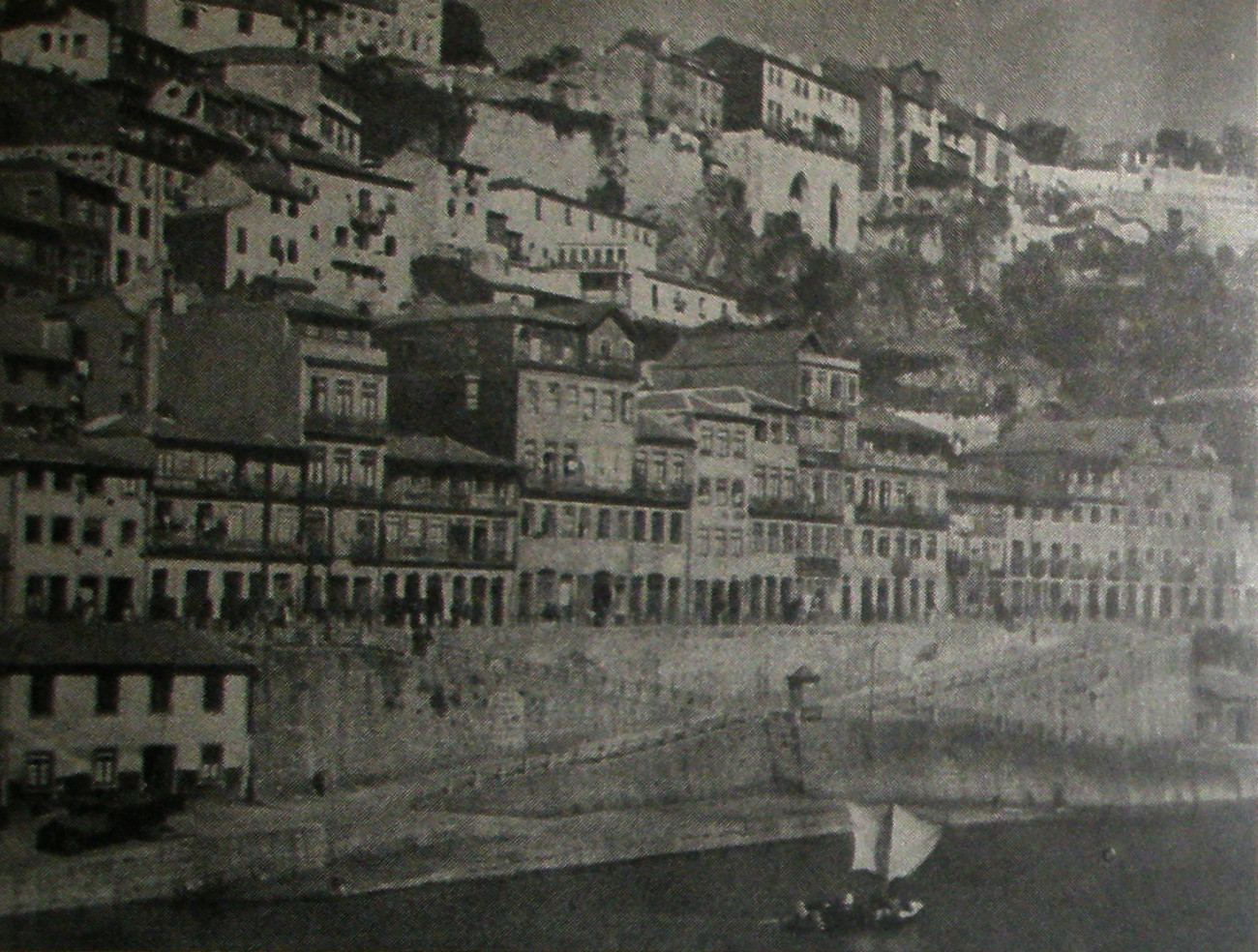
View of the Porto riverside, published in the German propaganda magazine "A Esfera" on December 5, 1941.
To show oneself openly in the Legion as Germanophile is not advisable. For this not only the Germany-Russia understanding has influence, but also English influence and even more the Church. Known persons belonging to the Legion and the Youth have said things about the Führer that I prefer not to mention. The Legion is not reliable; it did not arise from goodwill, and therefore one does not know exactly what is desired.
People who are Germanophile, even minimally, and who cannot stand England were alarmed by the Russo-German pact.
I have my defence for this fact as well, but they do not want to believe. For many democrats it is water on the mill:
- Persecution of Catholics in Poland and Germany.
- Understanding with Russian atheism.
They forget, however, that democracy has only one god – MONEY.
We German Nazis are constantly watched and considered spies. Nevertheless, we are very careful and respect the friendly country, as is customary for Germans. We do not mix our interests with the internal interests of the country. In Porto the work of the French consul is especially active against us.
Without being arrogant, like the English, many supporters still do not think as they should; they are afraid and timid. This is an old inheritance from the history of our people when far from the homeland and alone. Germans of this period should understand that there no longer exists the old care of the Fatherland for compatriots living abroad.
If German radio did not exist, we could only read the few news items in newspapers and would certainly become quite nervous and discouraged. As our Government prevented Germany from starving again as in the last war, it also prevented Germans from being without news from their homeland. No intelligent person can believe Jewish lies, since they have no logic. It is criminal falsehood that we are forced to read daily in newspapers. Even the public here begins to doubt. It began with German defeats in Poland and ended immediately, after 18 days, with an absolute German victory and not Polish. In the Russo-Finnish war the same happens.
During the 20 years I have lived abroad, 13 years in Spain (Madrid) and 7 years in Portugal, I have noticed much persecution against Germans. Since September 1939 it seems that all unscrupulous elements in favour of the Allies conduct an unprecedented persecution. Not a single day passes in which English aircraft do not fly over Berlin, Vienna, Prague, etc. Now they also fly over Poland. No one can understand this and one asks where these English aircraft were when Poland was at war with us.
Yours sincerely
Heil Hitler
Max Arglebe
PS:
Today, Monday, the Porto press publishes for the first time Hitler’s speech in full, and this on the front page.
Regarding radio, I have the following to say:
Reception on medium waves (German stations) is possible from 18:00 German time. Reception is unfortunately very weak, but after 22:00 it is regular. Would it not be possible to increase strength by 20–30 percent? Dutch, French and English medium-wave stations are generally stronger, and often Bremen, Hamburg, Cologne, Munich, Frankfurt cannot be heard; in general other stations are stronger. On the Cologne station there is a very strong French transmitter that generally prevents reception, which is not the case on the Frankfurt station.
The station for Africa does not have clear distinction from 18:00 to 21:00; the music is not very clear. Speeches can be heard better. A Russian station and another English one must be too close. The Asia station is very good from 6:00 to 17:00 local time.
Heil Hitler
M. Arglebe
Carlos Guerreiro
Fontes/ Sources:
"Royal Air Forces Bomber Losses in the Middle East and Mediterranean"- David Gunby & Pelham Temple § Evade & Escape Report - National Archives London Kew § "The Winnipeg Evening Tribune" trough Manitobia.ca § Commonwealth War Graves Commission § Canada's Air War 1941 § Diário de Lisboa
