.
.
.
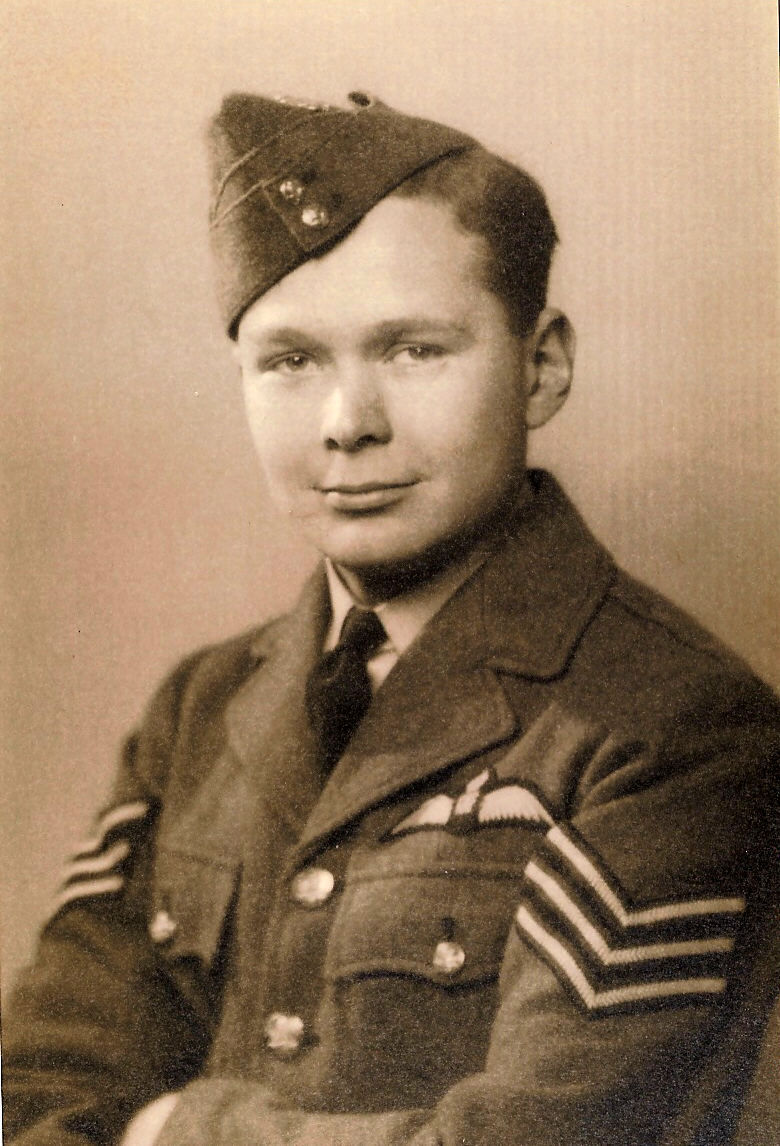
Leslie Alec Hayward in his sergeant's uniform. When he disappeared in 1944 he was already an officer.
(Picture: Leslie Hayward Family)
Date
Location
Force
Aircraft
From-To
Crew
16-06-1942
Santa Maria island, Faro
RAF 58 Sqn
Armstrong Whitworth Whitley Z9291
St. Eval (GB) → St. Eval (GB)
F/Sgt Leslie Alec Hayward GB
Sgt J. W. Walsh Canadá
Sgt T. Linton GB
Sgt F. Hill GB
Sgt C. D. Young GB
Sgt V. C. Wyser GB
On the morning of June 18, 1942, the plane was on anti-submarine patrol in the Bay of Biscay when the crew spotted a U-boat. Depth charges were dropped at low altitude - about 50 feet (just over 15 meters) - but due to a mechanical problem, two 250-kilo bombs were also released.
As they had fuses that reacted to impact, they exploded as soon as they touched the water and the aircraft - which was right over the impact zone - suffered significant damage to the fuselage and controls.
Only Alec Hayward's skill prevented the English from crashing into the sea immediately. With few options, he tried to reach the nearest land, which in this case was the Spanish coast. As the plane was holding up in the air, the decision was made to attempt to reach Gibraltar, always with land in sight. In the south of Portugal, the fuel ran out and Hayward had to make a forced landing near Cabo de Santa Maria, in the Faro area.
For his efforts and skills in saving the crew, Hayward was awarded the Distinguished Flying Cross (DFC).
The landing took place at midday, right next to the surf, and the crew tried to set the plane on fire but were prevented by members of the local Border Police who rushed to the scene. The English were initially housed in the their building on the island.
The crew was sent to Lisbon and then to Caldas da Rainha where they arrived on 24 June escorted by a member of the Portuguese International Police - PVDE. The period of internment was short as they were already in Gibraltar by 6 July.
Hayward was reported missing in action on 12 March 1944.
The bomber stoped so close to the waterline that it was partially submerged whenever the tide came in. The lack of resources prevented the authorities from towing it to a less exposed area.
On 23 June, Major-Engineer António Jimenez Gonçalves went to the site to assess the condition of the plane. In the report that followed, he highlighted the existence of many areas already covered in rust.
The possibility of dismantling it and transferring it to a naval vessel was raised, but none were available for this type of service. The solution was to dismantle the various sections, place them on barges, cross the Ria Formosa and then ship everything by train.
A recovery team from the Military Air Force of Air Base No. 2 with a technician from the General Workshops of Aeronautical Material (OGMA) were sent to the site. On 7 July, the recovery team was already in Faro, travelling daily from Faro to the island in a longboat belonging to the Culatra Shipwreck Relief Institute. The remains of the plane were placed on barges that crossed the Ria Formosa, driven from one side to the other, by the tugboat belonging to the Faro Autonomous Council.
On 9 July the material was all in Faro and was on rail on the way to Alverca where it entered the Aviation Material Depot.
Carlos Guerreiro
Sources:
Evade & Escape Report - National Archives/ London Kew § "rafcommands.com" § Family of Alec Hayward § Jornal "O Algarve" § Banstead History Research Group § London Gazette
