Ganda (Portugal)
Captain: Manuel Paião
Type: Cargo Steamer
Tonnage: 4333 GT
Owner: Companhia Colonial de Navegação
Homeport: Lisbon
Built: Flensburgo, Germany (1907)
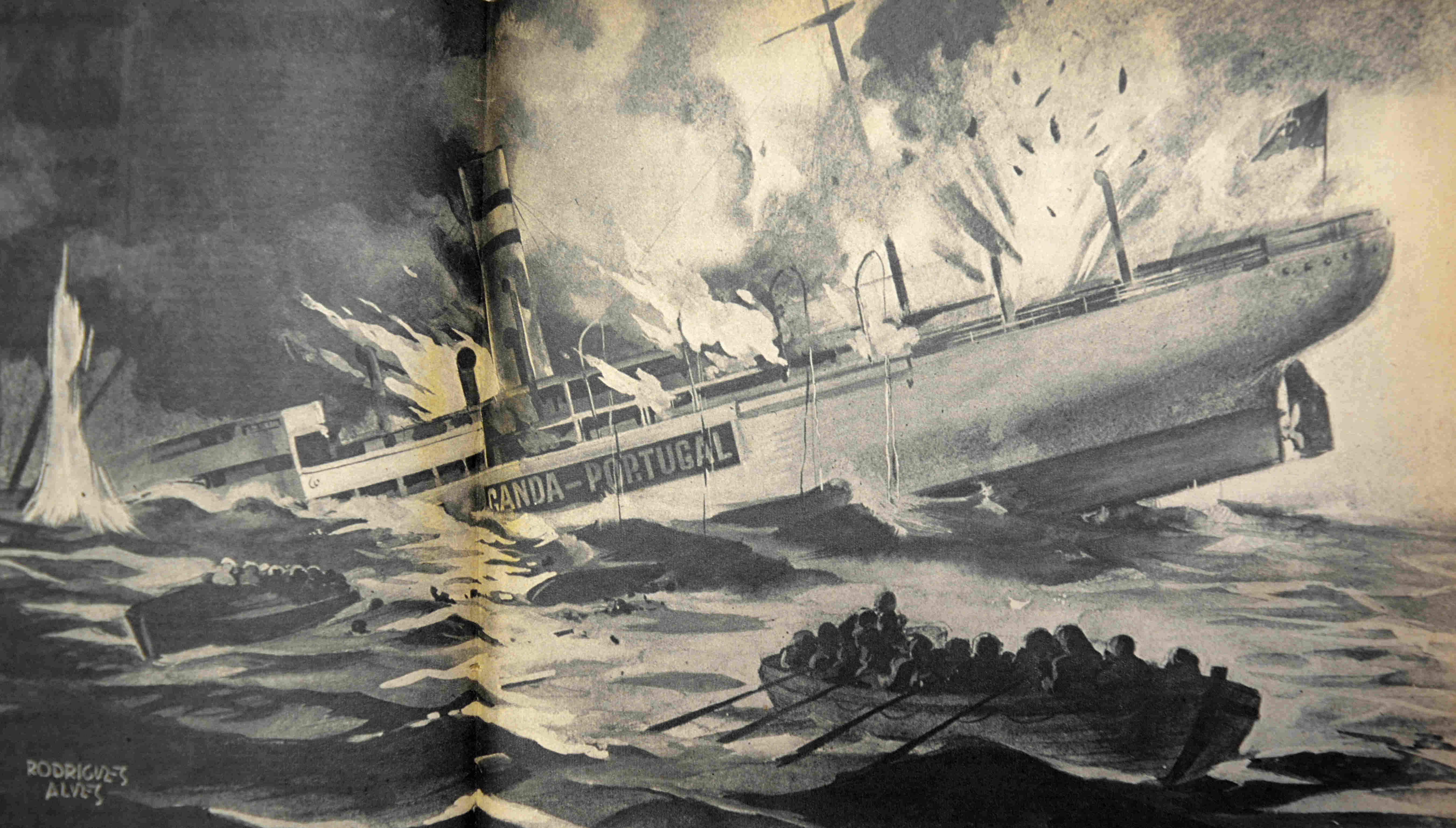
Illustration by Rodrigues Alves recreating the sinking of the Ganda
(Picture: "O Século Ilustrado" Magazine "Navios e Navegadores")
"A tremendous explosion struck the hull on the starboard side, between the bridge and the boiler room. (…) The side of the ship suffered a huge gash, big enough for a train to pass through." This was how the captain of the Ganda described the attack on his ship, in a statement given to the navy days after the tragic event. The Portuguese vessel, which had left Lisbon bound for the African colonies, was struck by a torpedo – on 22 July 1941 – dozens of miles off the coast of Morocco.
Fifteen minutes before the explosion, the Ganda had been "shaken with some violence, giving the impression that they had hit some submerged object." Captain Manuel Paião stopped the engines to inspect the hull and lower decks. Water was found in one tank, but nothing significant, and there was no time for further checks, since the torpedo tore into the ship ten minutes after the collision with the "submerged object." In statements given later, the crew said they believed the initial impact must have resulted from a submarine's torpedo wish failed to explode.
Given the damage, the order to abandon ship was given immediately, but of the four lifeboats on board, one was destroyed in the explosion and two others capsized after being launched, owing to the state of the sea. So the captain also ordered a motor launch to be put into the water, a vessel normally used to assist manoeuvers and towing in African ports, where proper facilities did not exist.
Of the 72 people on board, 50 were crew, five were cattle handlers and fifteen were passengers. There were also two stowaways.
Shortly after 7.30 pm, Manuel Paião took his place in the only lifeboat that survived and picked up several people who were in the water. He gathered 26 survivors into his boat, while the rest took their places in the motor launch.
A slender periscope with a round window was seen passing within ten metres. Later the submarine surfaced and fired several rounds from its deck gun in an attempt to sink the ship, but by four in the morning, by which time the lifeboat was already some distance away, the glow of the flames still burning fiercely on board could still be seen.
Ironies of war
Like other Portuguese ships, the Ganda bore the markings of neutrality. On both sides of the hull was painted the national flag and, in white letters a metre and a half high, the ship's name and the word "PORTUGAL." At the main mast flew a national flag, and clearly visible beneath the bridge was another flag – of canvas, three by two metres – lit up at night as well. None of it was of any use…
Amid the confusion, the two boats carrying survivors went separate ways and never sighted each other again.
It is possible that Captain Manuel Paião viewed the situation with dread, but also felt the irony of the moment. A month earlier, he had rescued 24 survivors from the British tanker British Grenadier, and now he too was a castaway. The British ship had been sunk on 22 May off Guinea, also by a submarine. The 49 Englishmen had spent little time in the lifeboats, since the Ganda, along with a Spanish steamer, had managed to pick them up and land them in Freetown, Sierra Leone.
The crew members of the Ganda who died, and some crew members of the Fafe, who rescued survivors from the Portuguese merchant ship.
(Picture: "O Século Ilustrado" Magazine)
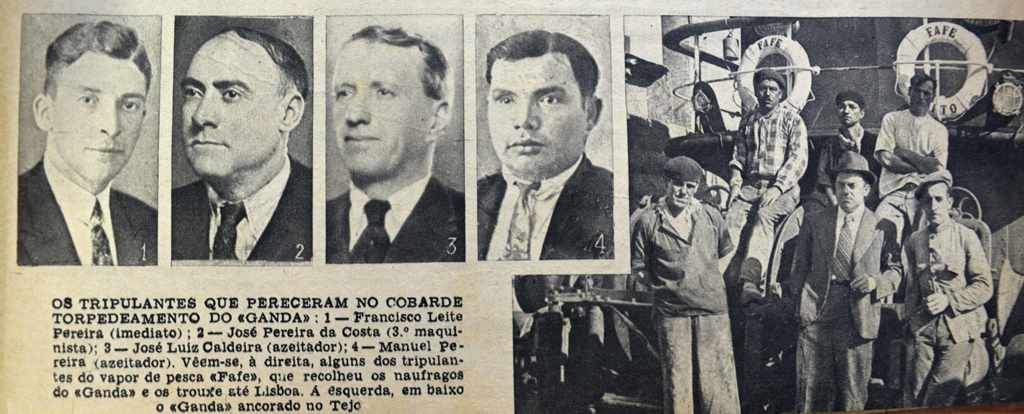
The explosion had damaged Ganda's radio, and it had not been possible to send out any distress signal. Adrift off Morocco, Manuel Paião was fortunate, since the very next morning his lifeboat was spotted by the Portuguese fishing vessel Fafe. News of the disaster reached Lisbon shortly afterwards.
The captain knew that four of the crew had died in the explosion, but he had no idea what had become of the launch carrying most of the survivors.
The agonising wait
As soon as the disaster became known in Portugal, the Navy sent a ship to the area, and Naval Aviation carried out several patrols to locate the survivors. French aircraft based in Casablanca did the same. None had any luck.
The shipowners' headquarters, the Companhia Colonial de Navegação (CCN), on Rua Instituto Virgílio Machado, flew its flag at half-mast while receiving relatives of the missing, representatives of other shipping companies, military officers and government officials.
.
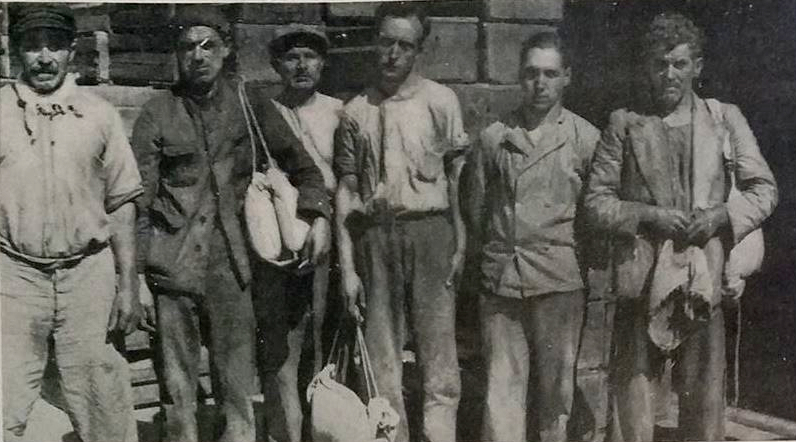
Some of the Ganda survivors rescued by the Fafe.
(Picture: "Vida Mundial" Magazine)
The newspapers reported on the comings and goings at CCN's headquarters and the lack of news. It was known that the launch had neither enough food nor fuel to reach land. It was certainly not the best type of vessel to be shipwrecked in… it had simply been a last resort.
As the days passed, the mood grew ever more somber.
News arriving on the afternoon of the 24th lifted the gloom… the survivors had reached the port of Huelva, in southern Spain.
It was just as the Portuguese were losing hope – three days after the torpedoing – that Captain José Perez Florêncio, of the Spanish trawler Gonzales Ventura, found them. The trawler was 80 miles off the Moroccan coast, loaded with fish, when it noticed the small vessel.
On board were 41 survivors, among them five women and a child, who would earn special mention in the press: "On the whole, the ladies bore themselves well and lifted everyone's spirits, even in the moments when thirst, the tragedy of the vast, lightless sea, the anguish, hunger and even cold – for some were almost naked – drove them to tears; they behaved with dignity. They raised their hands to the sky and called out to God," wrote the Diário de Lisboa, which, in its edition of the 25th, reporting on telephone conversations held with the Portuguese consul, Captain Florêncio and several of the shipwrecked in Spain.
.
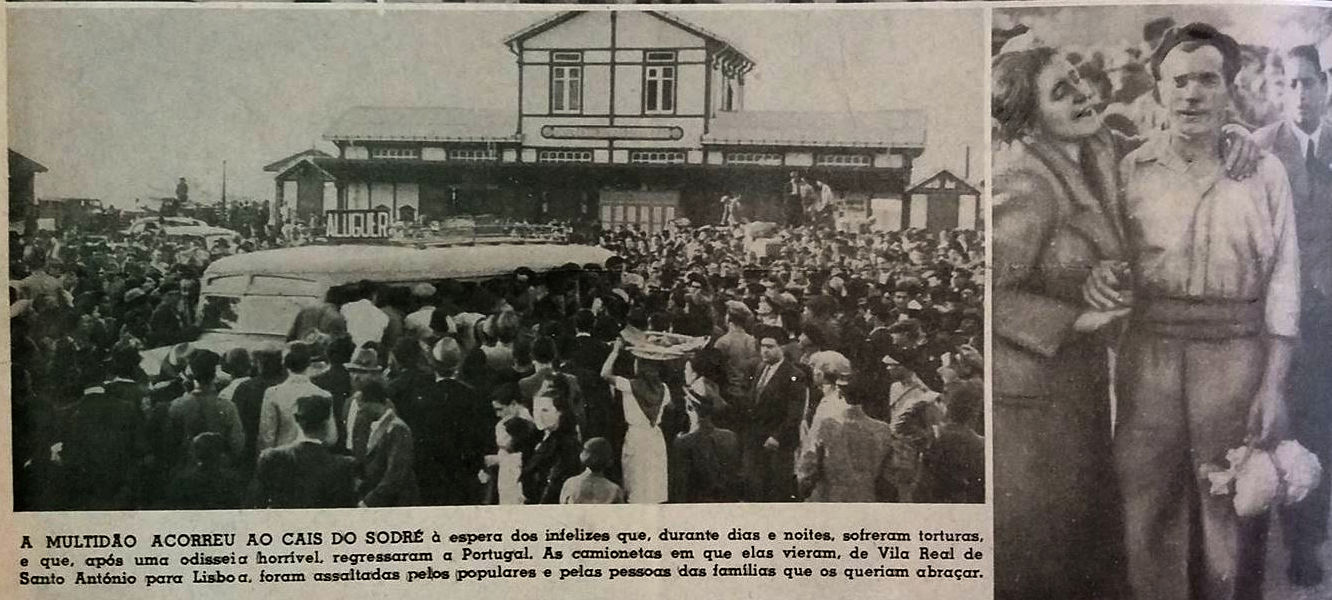
Arrival of busses from Spain with survivors of the Ganda.
(Picture: "Vida Mundial" Magazine)
We also learn that one of the women, "Mrs" Rosa de Araújo Ribeiro, "suffered a severe crisis, which fortunately passed," and that an eight-year-old boy cried for hours on end from thirst. He was calmed by being given salt water to drink…
Thirty-seven survivors arrived by coach in Lisbon on the morning of the 26th. Four, more exhausted or injured, stayed behind, returning later. At sunrise the coaches pulled into Cais do Sodré, where they were awaited by relatives and "a great many people," who cheered "long live Portugal and its merchant navy."
The Attack by U-123
It is possible that the initial impact felt on the Ganda, just before the explosion, was indeed a torpedo; the *U-123* fired two, but only one detonated.
The Germans saw the crew abandoning ship and fired another torpedo, yet the freighter did not sink. They were forced to surface to finish the attack with deck-gun fire, and left the Ganda in flames.
Only when they approached the lifeboats did they realize they had sunk a neutral ship, prompting them to withdraw. Later, the record of the attack was erased from the official log.
Carlos Guerreiro
Sources:
Arquivo Histórico da Marinha (PT) § Arquivo Histórico do MNE (PT) § uboat.net § Lista dos Navios da Marinha Portuguesa, datas 1939 a 1945 § Diário de Lisboa § Diário de Notícias § O Século Ilustrado § Vida Mundial
