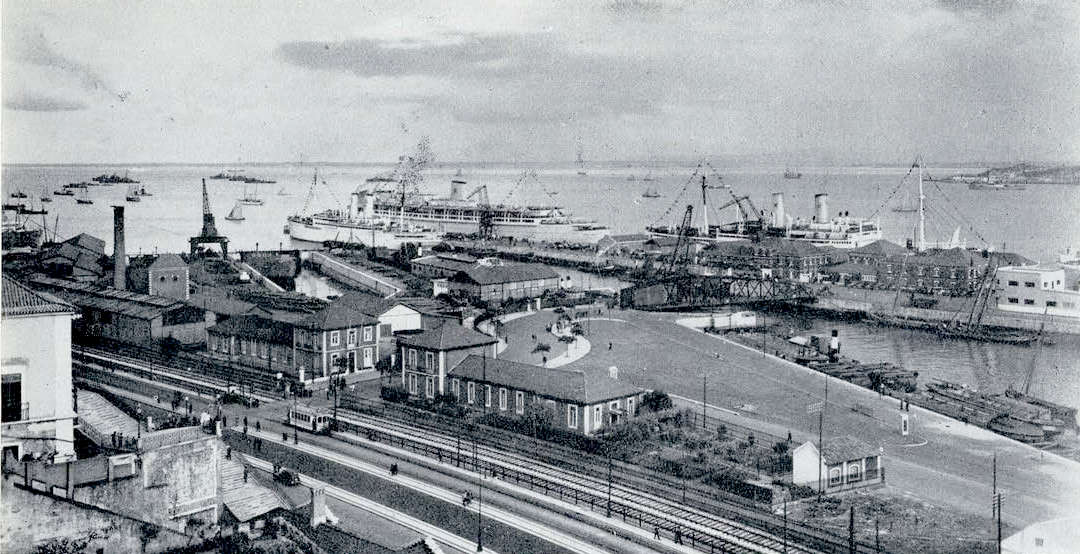
The Lisbon Harbor
(Picture: "Panorama" Magazine, June 1941)
Arendskerk
(Netherlands)
Captain: Cornelis Wijker
Type: Motor Merchant
Tonnage: 7,907 GT
Owner: NV Vereenigde Nederlandsche Scheepvaart Mij
Homeport: The Hague
Built: Danzing (1938)
On the morning of January 17, 1940, the Dutch ship "Poelau Bras" arrived in Lisbon, carrying 62 survivors from the cargo ship "Arendskerk" - of the same nationality - which had sunk on the 15th following an inspection by a German U-boat that detected contraband for England in the cargo.
Among those arriving were eight men from Mormugão, in Portuguese India. Their names were Francisco Piedade, Sebastião Fernandes, Mariano Diniz, Remédios Dias, Custódio Martins, José Silveira, Saúde Rodrigues and António Diniz. Their main concern - when they spoke to journalists - was whether they would be able to visit Lisbon, which none of them had ever been to.
The survivors were housed in diferent hotels around the city and, the following day, in addition to bureaucratic issues, the purchase of clothing for the crew and passengers was authorized.
The Malays and Javanese crew members embarked on the 18th for Batavia, now Jakarta, while the captain and officers left on the "Sud" for Holland on the 20th.
It was not possible to determine when the Portuguese from Mormugão left for home, but their presence caught the attention of one of the filmed news bulletins - the Jornal Português - the monthly propaganda and news magazine shown in movie theaters.
The Arendskerk was intercepted by U-44, which fired seven shots to stop it. The first mate, Johan Oostermeis, took the documentation to the submarine for inspection and, as the cargo manifest indicated goods for the United Kingdom, the Germans considered that they were contraband of war.
The Dutch had half an hour to abandon the ship before a torpedo was fired, which split the ship in two. Only the stern sank and half an hour later the U-boat fired 18 more shots with its artillery piece to submerge the bow.
After the sinking, the survivors spent several hours in lifeboats until they were found by the Italian ship "Fedora", which then passed them to the "Poelau Bras".
Carlos Guerreiro
Sources:
Biblioteca Central de Marinha - Arquivo histórico § Uboat.net § Diário de Lisboa
